Home
Do School Uniforms Fit?
by KERRY A. WHITE


School districts increasingly test one-style-fits-all dress policies to promote positive attitudes


School leaders in the Ridley School District in suburban Philadelphia weighed carefully their decision to require school uniforms last fall.


Parents were surveyed and community concerns were aired before the nine-member school board's unanimous decision in July to adopt a mandatory uniform policy for students in grades kindergarten through five.


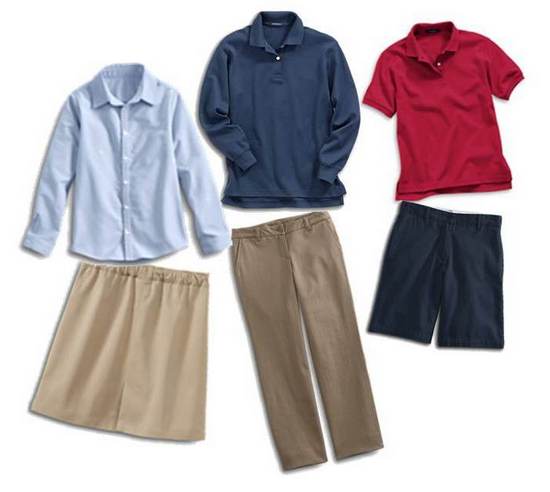
Under the new policy, the district's elementary school students are leaving their baggy pants and crop tops in the closet on school mornings to don regulation khaki pants, shorts or skirts "of the appropriate size" and hunter green or white shirts, which must be worn tucked in.


Ridley officials say the new policy is intended to foster a team learning environment and help teachers and administrators maintain order.


"We wanted our school district to be ahead of the curve," says John R. Cleghorn, director of support services in the 5,700-student district. "We think it will reduce disciplinary problems, improve school spirit and classroom behavior and make it easier for school staff to identify who belongs on campus."


Ridley schools are among the first in Pennsylvania to take advantage of a 1998 state law that allows school districts to set their own dress codes. And as policymakers and school officials race to find solutions to hard-to-solve problems ranging from low student achievement to school violence, the district is part of a growing movement nationally to adopt the one-style-fits-all dress policy.


Wider Acceptance


The idea is not a new one. School uniforms have been mandatory in private and parochial schools for centuries, but they've only emerged as a popular policy option for public schools in the last decade or so--this despite the fact that school uniforms never have been singled out as a main factor in private and parochial schools' success.


"They're a relatively recent phenomenon," says Ronald D. Stephens, executive director of the National School Safety Center at Pepperdine University in Westlake Village, Calif. "In the wake of school shootings, communities and schools are much more willing to embrace uniforms as well as a number of other strategies to enhance student safety."


While there are no national data quantifying the number of schools nationwide that have adopted school uniform policies, scattered surveys give an indication of their growing numbers.


In a 10-state survey by the National Association of Elementary School Principals and the clothing company Lands' End two years ago, 11 percent of elementary and middle school principals said their schools currently mandated uniforms, and 15 percent said their schools were considering adopting them. By contrast, only a few public schools were experimenting with uniforms a decade earlier.


Their overall acceptance is growing too. In a national survey of 1,000 parents last May by Lands' End, which has come out with its own line of school uniforms, 18 percent of respondents said their children would be in uniforms this school year, and 56 percent said they would support school uniforms if their schools adopted them.


All uniform policies, of course, are not the same. Some are very loose, requiring that students abide by more of a dress code--navy or khaki pants and white shirts of their choosing, for example. Others require students to purchase the same selection of clothes from a chosen manufacturer. While most schools allow students to opt out of uniforms for religious or personal reasons, some do not.


One District's Lead


Public school uniform policies date back to the 1980s, when selected schools in Washington, D.C., Baltimore, Miami-Dade County, Bridgeport, Conn., and Detroit began requiring them.


In 1994, the Long Beach, Calif., Unified School District was the first in the nation to require uniforms in all elementary and middle schools. Like other urban school uniform policies, Long Beach's was intended to curb gang problems, and school officials not only credit it with having accomplished that goal, but also say uniforms have brought about a substantial drop in school crime, a drop in school suspensions and disciplinary problems and improved student attendance rates and academics.


Today, students in all 57 of Long Beach's elementary schools, all 15 of its middle schools and one high school are wearing uniforms.


"We've seen significant improvements in student behavior and student achievement," says Dick Van Der Laan, spokesman for the 93,000-student district. He says the district's test scores are up across the board and absenteeism and suspensions are the lowest they've been for more than a decade. "School uniforms have helped us set and achieve high standards and helped to create a setting that says you're here to learn."


After hearing about Long Beach's much-touted success, President Clinton went on to endorse the idea in a March 1996 speech, saying: "If it means that the school rooms will be more orderly and more disciplined and that our young people will learn to evaluate themselves by what they are on the inside, instead of what they're wearing on the outside, then our public schools should be able to require their students to wear school uniforms."


Soon after the president's endorsement, the U.S. Department of Education sent a school uniform manual to every school district in the country. The guide, "School Uniforms: Where They Are and Why They Work," listed the potential benefits of school uniforms, including a decrease in violence and theft, a decrease in gang activity, less peer pressure and better discipline.


From there, school uniform policies took off, especially in urban districts. Today, nearly half of the nation's big urban school systems have adopted school uniform policies for all or some of their schools, according to the Washington, D.C.-based advocacy group, the Council of the Great City Schools.


"While they're not universally accepted, some cities [with uniform policies] find that it helps decrease crime and violence," says Michael D. Casserly, the council's executive director. Urban school leaders have reported "it also helps to take the emphasis off things that aren't related to academics," he adds.


Suburban Spread


But the trend has not limited itself to urban schools. The latest school systems considering school uniform policies are, like Pennsylvania's Ridley, largely suburban.


While most of these school systems have fewer problems with school violence and discipline than their urban counterparts--fewer gangs and weapons, less antagonism over status clothes and better student achievement overall--officials are banking on some of the same positive payoffs of which their urban counterparts boast.


"We want to help remove some of the stigma associated with clothes," says Margo Olivares-Seck, superintendent of the 4,700-student Dysart Unified School District in Surprise, Ariz., a suburb of Phoenix. Under her district's policy, school-based councils, made up of parents, teachers and the school's principal, decide whether their schools should adopt uniforms. This year, students at five of the district's seven schools are requiring students to wear navy blue pants or shorts and white, collared shirts.


The number, says Olivares-Seck, could grow soon to include all district schools. "It's great to see kids so well dressed," she says. "You don't see boys in big, baggy pants that let their underwear show or girls in spaghetti straps ... . It's helped to set an atmosphere that school is a place of learning and a place of business,"


Other school leaders say that in the wake of several recent school shootings, including the Columbine High School incident last April, they want to be assured they're doing all they can to prevent school violence.


"Suburban and rural schools are not exempt from big problems," says Arkansas state Sen. Kevin A. Smith, who sponsored a bill that passed during the last legislative session that requires local school boards to consider adopting school uniforms. "I think they're a good thing all-around. It teaches more respect for schools and teachers, and it creates a more team-oriented and orderly atmosphere ... I'm a parent and know the incendiary influence of clothing and appearance. Uniforms help take some of that pressure off."


Anecdotal Evidence


Despite Smith's beliefs and those of likeminded policymakers and school officials, research on the effects of school uniforms has been inconclusive or mixed.


In a 1995 study seeking an answer to the question of whether dress codes and school uniforms can help curb school violence and other antisocial behaviors, Lillian 0. Holloman, a professor in the department of clothing and textiles at Virginia Polytechnic Institute and State University, concluded that it depends on whom you ask. That's because much of the debate between advocates and opponents, she says, is based on anecdotal accounts rather than scientific data, which is difficult to extract.


But a 1996 paper on school uniforms and school safety by M. Sue Stanley, a professor of education at California State University at Long Beach, says uniforms can "reduce the emphasis on fashion wars" and, in the long run, help reduce the financial strain of clothing costs on low-income families. Stanley says school uniforms can help encourage students to concentrate on learning, rather than on what to wear, and are "social equalizers" that help to promote peer acceptance and school pride.


A 1997 study by David L. Brunsma, an associate professor of sociology at the University of Alabama in Huntsville, and Kerry A. Rockquemore, an assistant professor of sociology at Pepperdine University in Malibu, Calif., however, says school uniforms "have no direct effect on substance use, behavioral problems or attendance." And, contrary to other studies and hundreds of anecdotal accounts, the authors find a negative effect of uniforms on academic achievement.


"Instituting a school uniform policy can be viewed as analogous to cleaning and brightly painting a deteriorating building," they conclude. "On the one hand, it grabs our immediate attention. On the other hand, it is of paint."


Perhaps the biggest opposition to school uniforms and dress codes has been based not on research but on legal concerns, with opponents arguing that requiring students to abide by a strict regimen violates their constitutional right to freedom of expression.


In a landmark 1969 decision, the U.S. Supreme Court ruled in Tinker v. Des Moines Independent Community School District that students "do not shed their constitutional rights at the school house door." At issue were three Tinker children--John, Jane and Sarah--who had been sent home from school for wearing black armbands in protest of the Vietnam War. The U.S. Supreme Court has never since directly addressed school uniforms. And while most lower court challenges to school uniform policies and dress codes citing that decision have been more trivial in nature--lawsuits have been brought over students' rights to don sagging pants and offensive T-shirts, for example--court decisions generally have upheld the constitutionality of uniforms and dress codes, according to Richard Fossey, a professor of education at Louisiana State University in Baton Rouge and an expert on student dress codes.


"I don't think we've heard the last word on [school uniforms]," he says. "But my guess is that courts will be friendly to them. Judges are more aware of violence and other problems in schools and I think they'll be more receptive to school uniforms" as a means to improve schools.


Still, most civil libertarians remain opposed to the idea. Loren Siegal, the director of the public education department of the American Civil Liberties Union, says uniforms distract parents and school officials from more pressing concerns facing schools like crumbling school buildings, overcrowded classrooms and dwindling school funding.


"The debate over uniforms is a diversion," Siegal writes in an ACLU policy paper on the subject. "Attractive, modem and safe school buildings, small class sizes, schools with well-stocked libraries, new computers and an array of elective courses like music, drama and art-- those are the kinds of changes that would produce long-lasting and dramatic improvements in student deportment and achievement."


Alternative Actions


The unresolved debate has prompted many school officials to study the issue carefully before jumping headlong into a school uniform policy.


After much ado last spring, school officials in Fayette County, Ga., for example, decided to tighten their schools' dress codes instead of adopting uniforms this school year. John D. DeCotis, superintendent of the 20,000-student system in suburban Atlanta, says parents were looking to school officials to restore order to schools after several local Columbine-inspired pranks last spring, but ultimately a task force concluded there were better ways for the district to address school safety.


"There's research on both sides, and I see advantages to both sides," DeCotis says. "But in the end, my responsibility is to do what the community wants," and the community did not want uniforms.


The Marple Newtown School District in Newtown Square, Pa., opted for a dress code rather than school uniforms last year. Tube tops and halter tops, cutoff shorts, clothes promoting drugs or alcohol, short shorts and oversize trousers are all verboten now.


"Going from a loose dress code to school uniforms seemed like a knee-jerk reaction," says Raj K. Chopra, superintendent of the 4,000-student suburban Philadelphia school system. "It seems like an easy solution, but our goal was to get students to dress for success. [We wanted] to create a sense of responsibility on behalf of students."


But other school officials have been less tempered in their approach.


The Polk County, Fla., school system outside Tampa may be the first district in the nation to adopt a school uniform policy from which students cannot opt out. The district instituted a school uniform policy for its elementary and middle schools in 1996, but so few students complied with the dress codes that the school board voted 4-3 last spring to remove the opt-out option, beginning this school year.


Under the new policy, which a group of parents is challenging in court, the only students who can go without a uniform are those wearing other uniforms to school, such as Girl Scout outfits or students with "serious and sincere" religious beliefs that prevent them from abiding, district superintendent Glenn Reynolds says. All other students are required to wear navy, black or khaki-colored slacks, shorts or skirts, with navy- or white-collared shirts. Polk students who show up out of uniform--with no good First Amendment claim to back them--face immediate suspension.


Before tightening its policy this year, Polk County's dress code "was a real horror story in terms of enforcement," Reynolds says. But the new policy has "been a tremendous success. Parents and the community have been extremely supportive, and teachers and principals think it's great."


Of the 54,000 elementary and middle school students required to wear school uniforms in Polk schools, only a few have showed up in street clothes and been sent home. Reynolds says he's confident the school system will prevail in court. At least one court decision is on his side: An Arizona state judge in fall 1995 upheld a Phoenix middle school's uniform policy, which like Polk County's, did not include an opt-out provision. The decision was one of the first legal tests of school dress codes.


Sparing the Dramatics


Few superintendents feel such Draconian measures are necessary, however. And in an effort to avoid ruffling too many feathers and avoid litigation, most school systems moving to uniforms will continue to allow students to opt our.


Indeed, many administrators say parents and students are so satisfied with school uniforms that there's no need to force the issue. "So far the reaction's been very positive," says Cleghorn of the Ridley, Pa., schools, which are requiring school uniforms in all seven elementary schools this year. "We've had very few complaints."


Things are going so well in Ridley, in fact, that the district is planning to survey parents of middle and high school students on the prospect of adopting school uniforms in their children's schools later this school year. If their support is as overwhelming as elementary school parents'--parents by a 7 to 1 margin favored the new policy-- all the district's students could be in uniform by next fall.


Kerry White is a Washington, D.C.-based staff writer with Education Week.


A Mixed Bag of Uniform Research


Research on the effects of school uniforms has been either inconclusive or mixed. Here's a summary of what the major studies to date have had to say:


* A 1997 study, "Effects of Student Uniforms on Attendance, Behavior Problems, Substance Use and Academic Achievement," concluded that, contrary to national opinion and the testimony of thousands of school administrators, "student uniforms have no direct effect on substance abuse, behavioral problems or attendance."


The researchers, David L. Brunsma, a sociologist at the University of Alabama, and Kerry A. Rockquemore, a sociologist at the University of Notre Dame, found a negative effect of uniforms on academic achievement. The study used 10th-grade data from the National Educational Longitudinal Study of 1988.


Their research also undermined the Long Beach, Calif., school district's assertions that school uniforms led to a decrease in crime and better student achievement. Along with school uniforms, the researchers say, Long Beach officials implemented several additional reform efforts, including new content standards. Given these efforts, they said, school uniforms shouldn't be credited as the sole factor in the district's new successes.


The study was published in the September/October 1998 issue of The Journal of Educational Research.


* A 1997 policy study by the Reason Public Policy Institute, "School Violence Prevention: Strategies to Keep Schools Safe," examined how school uniform policies fit into a school district's overall school safety and improvement campaign.


Researchers Alexander Volokh and Lisa Snell concluded there's no onestyle-fits-all strategy to combat school violence and improving schools. "If all schools were the same, in demographically similar neighborhoods, with similar crime rates in the surrounding community, with similar quality teachers and similarly committed staffs and similar budgetary constraints," the researchers conclude, "then we would feel safe advocating a common policy for all schools. But schools are self-evidently not like that. The ideal violence prevention policy will likely be different for each school."


The institute's Policy Study No. 234, can be ordered via the Web at www.rppi.org/es234.html.


* A 1996 paper, "School Uniforms and Safety," by M. Sue Stanley, a professor of education at California State University at Long Beach, says school uniforms can "reduce the emphasis on fashion wars and reinforce the acceptability of more practical, less costly school clothing."


The study also concludes that uniforms can reinforce the connection between school, work and success and thus help to promote better overall student achievement. "Uniforms may have a positive impact on school safety," the study say. "Because they are a low-cost intervention that is unlikely to do harm, it appears that they are well worth considering."


The study was published in the August 1996 issue of the journal Education and Urban Society.


* A 1995 study entitled "Violence and Other Antisocial Behaviors in Public Schools: Can Dress Codes Help Solve the Problem?" by Lillian O. Holloman, a professor of clothing and textiles at Virginia Polytechic Institute and State University, identifies clothing-related problems and explores the effectiveness of dress codes. The study identifies the problems that students can get into because of their clothes.


Gang colors and insignias, whether worn intentionally or unintentionally, can get a student jumped or worse, the study says. Status clothes, such as team jackets of professional sports teams, leather coats and designer sneakers, have led to thefts, sometimes by knife or at gunpoint. While school officials have resorted to dress codes and uniform policies to stem clothing-related problems, more research is needed on their effectiveness, it concludes.


The study was published in the Winter 1995 edition of the Journal of Family and Consumer Sciences.


On-line Resources


Looking for more about the use of school uniforms? Here are a few handy resources that you can find on the Web:


* "Manual on School Uniforms." A guide from the U.S. Department of Education that aims to assist school officials and parents in their decision whether to adopt school uniforms. www.ed.gov/updates/uniforms.html


* "School Uniform Fact Sheet." Facts and figures from the Long Beach, Calif., Unified School District. www.lbusd.k12.ca.us/uniform/uniforma.htm


* "Student Dress Codes." ERIC Digest 117 is available from the ERIC Clearinghouse on Educational Management, University of Oregon.eric.uoregon.edu/publications/digests/digest117.html


* "Litigating School Dress Codes" an Education Week commentary in March 1997 by Richard Fossey, a professor of education at Louisiana State University, and Todd A. DeMitchell, a professor of education at the University of New Hampshire, exploring the history of school dress codes and the courts. www.edweek.org/ew/1997/25fossey.h16
 
< Prev
© 2010 Term paper / research paper writing service