|
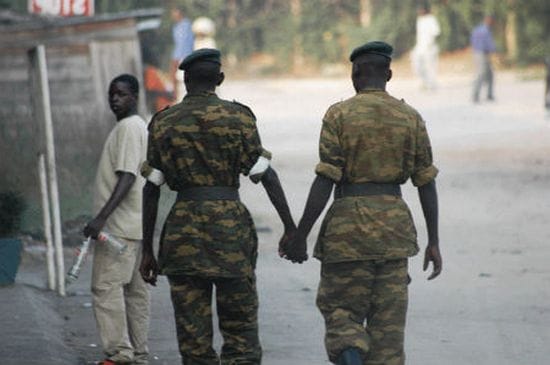
Gays in arms: can gays in the military work? In countries around the world, they already do.
by Eric Konigsberg Maybe Fort Bragg cadet Hallie Weinstein would have been better off if she had agreed to date the captain who asked her out. Once spurned, he began snooping into Weinstein's private life and reported to her superiors that she was a lesbian, a revelation that got her and her lover thrown out of the military. Surely Weinstein would have been better off had she been a soldier in the Dutch army. In the United States, the debate over gays in the military remains a war of abstracts: Defenders of the status quo rehash fears about unwelcome advances in the showers and warn darkly of morale problems, while critics of the gay ban continue to lob rocks at the policy from the moral high ground of human rights. But with our policy stuck in hypotheticals, the strongest argument for gays in the military is quietly made elsewhere--in countries such as Holland, Denmark, Sweden, Israel, and to a lesser extent France, where gays have already been integrated into the armed forces. While the Pentagon pursues a policy that every year hounds 1,000 able-bodied gay men and women out of the service--wasting $27 million in training costs annually--other countries demonstrate that with the fight mix of education and cajoling, a military with gays can work. Take Holland, where an estimated 12,000 soldiers--10 percent of the total force--are gay. Holland's government considered homosexuality grounds for dismissal until 1974, when the Association of Dutch Homosexuals convinced the minister of defense that gays posed no threat to national security. Nevertheless, gays could still legally be passed over for promotion simply because of their sexual orientation. But in 1986, Rene Holtel, then a major, was told by his commander that though he was an excellent officer, "he wouldn't want me to rise in rank because I was gay." Holtel went to his superiors and fought the camouflage ceiling, which was abolished in 1987, leading to the birth of the Foundation for Homosexuality in the Military, which Holtel, now elevated to lieutenant colonel, chairs. Holland's success stems from its effort to educate soldiers. Already required of officers and noncommissioned officers in the air force, and soon to be mandatory in the army and navy, is a four-day course known as Aeen Kwastie van Kyken, which roughly translates to "It's in the eye of the beholder." The seminar is designed to teach sensitivity toward minorities in the military, in particular women, blacks, and gays. Apparently it works. Rob Segaar, a 29-year-old veteran of the navy, summed up the Dutch attitude this way: "Suppose you're on the beach in a skimpy bathing suit. The guy next to you might be gay. Does that harm your morale? Is that dangerous?" Army doctors, priests, and psychiatrists will soon be required to complete coursework that will enable them to offer guidance to soldiers struggling with the decision to "come out." The Dutch department of defense recently published a booklet on homosexuality containing pictures of a lesbian couple embracing near a ship and a young man greeting his boyfriend in Amsterdam's Schiphol Airport after a stint in Lebanon. Denmark is another success story. There, success with gays in the military is the product of necessity: Service is mandatory and the country needs all the warm bodies it can muster. Discrimination and harassment have been outlawed in the Danish army since 1981, and are grounds for expulsion. The result: Danish gayrights advocates boast of prominent and openly gay military leaders and the armed services report no cases of threats to gays, morale, or national security since the policy was initiated. "It's not something you think about," says Stephen Arynczuk, a second lieutenant in the Danish air force. "Homosexuality, we know it's legal and it's not an issue." Asked what kinds of problems were encountered with gays among their ranks, Danish Brig. General Kristian Anderson responded, "Problems? No, should there be? I've been in the air force since 1954, and I can't remember one problem caused by someone being a homosexual." Who else doesn't discriminate? Sweden has no ban, and Norway's government states that "Anyone who in written or oral form is threatening, scorning, persecuting, or spiting a gay or lesbian person will be punished with fines or prison for up to two years." The Swiss don't discriminate, though gay soldiers, according to their regulations, are prohibited from forming cliques, whatever that means. And it's not just in progressive Nordic climes that gays have gained entry into the army. Only five out of the sixteen NATO countries have policies specifically restricting homosexuals and two of the five---Canada and Australia--are expected to lift their bans on gays in the military in the near future. Some countries have allowed gays into the service with obvious ambivalence. In France, for instance, gays are allowed into the military--which is nationally conscripted--but can exempt themselves by proving their orientation has rendered them psychologically abnormal. A soldier who is discovered to be a homosexual, and hadn't yet proclaimed his sexual orientation, will be referred to a doctor and then advised by his commander to resign--but he cannot be forced out. Not surprisingly, when 18year-old French men go though their required threeday physical and psychological exams for the military, many gays use the opportunity to claim to be unfit to serve. Franc Jucla managed to shirk his oneyear commitment by getting himself classified as "asocial," convincing an army psychologist he would not be able to control his homosexual urges in the army. Others weren't so lucky: "I have gay friends who were denied exemption and were told by their examiner, 'This will teach you to become a man,' "says Jucla. French soldiers reflect this odd mix of disdain and acceptance of gays. The army tends to view homosexuals, as Jucla puts it, as "more silly or weird than as a threat." While gays are no longer considered national security risks, there is a popular saying in the military, "On n 'est pas des enculers," which translates loosely to, "We're not getting buggered," and can be understood as, "There are no fags in this army." Still, Hugues Charboneau, a chief corporal, says that soldiers in his division know and do not mind that he is gay, and speaks highly of a homosexual commandant above him. "There are some homophobic remarks behind his back, but it doesn't go any farther than that," he says. "Really, it's largely ignored." Critics will answer that none of these countries offers a legitimate example of a working army with gays. After all, Sweden, Denmark, and Holland haven't had top-notch armies since the days of Beowulf. Australia and Canada never did, and the last time France made a respectable showing, ToulouseLautrec was still alive. But look at Israel, a nation surrounded by enemies and the possessor of one of the world's most battle-tested, successful armies. Uncloseted gays in the Jewish state are treated no differently than straights. Mandatory service draws every 18-year-old man and woman into the military, without exception. Said a recently Americanized Israeli soldier: "! had thought Israel was less tolerant than the United States, but when I enlisted, ! never witnessed any morale problems caused by homosexuals and didn't really hear any homophobic talk--nothing along the lines of 'He shouldn't be serving.' There were openly gay soldiers I encountered, but no one seemed to resent it. It's not even an issue. I don't know why it is in America." If this ex-Israeli soldier wanted to find out, he could read the hairy-chested alarms of writers like Newsweek contributing editor David Hackworth, who writes, "Civilian standards of fairness and equality don't apply down where the body bags are filled. Ask Marine gunnery sergeants and army platoon sergeants what a few gays would do to the fighting spirit of units." Why not ask a soldier, like Johan Bierkus, a Swedish corporal stationed in the coastal town of Musko who has trained and lived with gays? "I didn't think that there should be any gays in the military. I thought homosexuality was a bit crazy," he admits. "It scared me in the army, like you just don't know what someone like that is thinking when he's with you." But when Bierkus last year found himself sharing a small house with eleven other boat chiefs, one of whom was gay, he was unbothered. "He was a good leader and one of my best friends in the whole group," he says. "It wasn't such a big deal that he was gay." Next to the disintegration of the "spirit of the unit" that people like Hackworth fear, the most common excuse for bias against gays in the U.S. military has been fear of blackmail. Of course, the most recent instance of a gay soldier being blackmailed is generally believed to be in 1912, when Austrian Colonel Alfred Redl betrayed his country's secrets to the Russians. Israel takes the saner position that gays in the closet (those who, for example, may have informed their superiors of their sexual orientation, but on a confidential basis) can't get security-sensitive jobs while those who are out can work anywhere. But even some U.S. military brass seem ready to abandon this perennial comerstone of the gay ban. As Secretary of Defense Dick Cheney reported to Congress in July 1991, "I think there have been times in the past when [opposition to gays in the military] has been generated on the notion that somehow there was a security risk involved, although I must say I think that is a bit of an old chestnut." The next step will be for the United States to realize that gays can only be blackmailed if public knowledge of their sexual appetites will get them in trouble, which is possible for as long as homosexuality remains grounds for dismissal. F troop Education is too often offered as a pat remedy for changing attitudes and fighting discrimination. Reeducating soldiers would have to be more sophisticated than, for instance, the superficial efforts to change the minds of high schoolers abouts drugs with "Just Say No" buttons. An aggressive army training and indoctrination program would have to be aimed at both officers and enlisted men. Because American recruiters in the post-Soviet world enjoy a buyer's market for new talent, inveterate gay-bashers could be weeded out before they get into uniform. For soldiers who have already been through boot camp, the Holland example suggests that if the Pentagon was willing to supply the effort, gays could be integrated with no more upheaval than when blacks were integrated decades ago. As for costs, if any new education efforts cost taxpayers less than the $27 million we lose every year training soldiers and then throwing them out because they're discovered to be gay, letting gays into the army will save us money. In the meantime, the American public is slowly producing another compelling reason to drop the gay ban: The people want it dropped. Sixty-nine percent of all Americans, according to a 1991 Gallup poll, believe gays should be hired as armed forces members-that's up from 51 percent in 1977. With racial integration of the military, America's generals already proved that bigotry can be fought by fiat and force of will. The Tailhook incident behind it, the Navy is again about to show that it can alter the behavior of its underlings, this time with a top-down campaign to fight sexual harassment. The experience of other nations' armies with gays reinforces what has always been true here: Soldiers take their cues from above. If history is any way to tell, gays will be unwelcome in U.S. forces for as long as the military's high ranks cling to unreasonable rationales for excluding them. If conservatives are really interested in creating the most effective military possible--one with the fittest, sharpest soldiers-then a lieutenant who protested the expulsion of Hallie Weinstein's lover in a formal letter to Fort Bragg commanders has a simple, overdue suggestion: "The army cannot afford to lose soldiers like her but instead should be concentrating on efforts to eliminate the multitude of mediocre nonperformers."
|