Our benefits

24/7 customer support

Professional writers

No plagiarism

Privacy guarantee

Affordable prices

94% of return customers

Free extras

Free title page

Free bibliography

Free formatting

Free of plagiarism

Free delivery

Home
Mandating School Uniforms at All Grades
by PATRICIA L. PICKLES


When a proposed school uniform requirement was first raised in our school district, I admit some of my administrative colleagues had serious reservations. They were concerned that enforcing uniform wear by students would be burdensome and time-consuming and would not necessarily lead to significant changes in the school climate.


I'm pleased to say our initial doubts have been allayed by several documented improvements that have resulted largely from our 3-year-old dress code and school uniform policy in North Chicago Community Unit School District 187.


In a highly diverse school environment such as North Chicago, Ill., where more than 70 percent of the children qualify for the federal lunch program, the major challenge is to keep the focus on teaching and learning. Our mandatory K-12 school uniform policy is helping us do just that. We have raised academic standards and improved student behavior throughout our 4,800-student system.


Policy Particulars


The school board created a Uniforms Task Force early in 1997 to explore the feasibility of requiring every student to wear a uniform to school. Chaired by a board member, the task force was composed of six parent volunteers, a few teachers, several principals, the superintendent, the district's communications coordinator and several high school students.


Parents on the committee quickly endorsed the proposal. While the educators respected that view, they raised their doubts, too, fearing they would be spending precious time enforcing the use of uniforms every day.


Over a five-month period, the task force reviewed background research and visited a Chicago elementary school where uniforms were mandatory. A survey of all students to gather input elicited a limited response, but those who did favored the idea. A public hearing at the high school, attended by more than 100 parents, teachers and students, brought predictable support from most parents and criticism from most students.


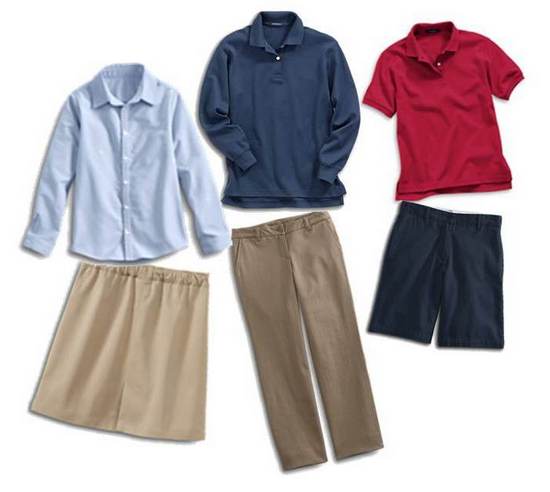
Task force members debated long and hard on policy specifics. They wanted clothing that would look like a uniform while being affordable. They also wanted to avoid being overly restrictive. They ended up with simple requirements that specified what colors could be worn and prohibiting particular styles of wear, such as denim, cargo pants, T-shirts, jogging tops, oversized clothing, transparent clothing, beach sandals and gang-related jewelry. The most difficult issue to resolve was whether to allow athletic shoes outside physical education classes and after-school sports.


To avoid constitutional challenges, the policy included a provision whereby parents could exempt their child from the requirement for financial or religious reasons. Students exempt from uniform dress would have the option of wearing business casual dress. Some task force parents didn't think anyone should be exempted, but they acquiesced when I insisted on legal grounds. To date, no exemptions have come before the school board.


The parents on the committee also wanted to require uniforms of all high school students immediately, but the high school principal--who had worked in another district that attempted unsuccessfully to impose uniforms on high school students--persuaded them to hold off until students, parents and educators had some experience with uniforms in the lower grades. The task force instead imposed a business casual dress code at the high school, with the understanding that uniforms would be required later if students violated the dress code.


Communicating Widely


The task force publicized the proposed policy through district publications and fliers were sent home with students. Posters promoting the benefits of school uniforms were placed in all 10 schools. Informational meetings took place at each school.


The board of education adopted the task force's proposal unanimously in June 1997 with little discussion and no objections from the audience. I attribute this display of unity to successful marketing and extensive districtwide communications.


Once adopted, the policy had to be communicated before parents began buying school clothes for the fall term. A brochure in Spanish and English detailed the requirements and listed businesses where uniforms could be purchased. The district also advised area department stores of the uniform policy and asked for their cooperation in providing good-quality, reasonably priced clothing that would satisfy the guidelines.


Through a grant program funded by Target, Project Success and the United Way, families unable to afford uniforms can obtain them without charge, but few families have requested this assistance. The task force also set up a swap shop, an exchange program staffed by volunteers where parents can bring used uniforms to trade for clothing in other sizes and colors.


Vigilant Enforcement


The business casual dress code that was introduced at our high school in fall 1997 turned out to be difficult to enforce. After two years of increasing noncompliance, the board approved a task force recommendation for mandatory use of uniforms in the high school. By this time, the principal believed students had been given ample warning that uniforms would be required if they failed to comply with the dress code.


The new policy took effect in August 1999. Violations were high during the opening few weeks, largely due to confusion over what was permitted, before dropping sharply. The policy works well but requires vigilance. Throughout the day, classroom teachers monitor student appearance to identify those who attempt to modify their clothing during the day.


When a student in a K-5 school is found to be out of uniform, a letter is sent home to the parent asking that the student be properly dressed in the future. Repeated infractions lead to a parent conference. In the middle schools, the parent is called about a first-time violation and asked to bring appropriate clothing to the school for the child. If parents or guardians are not available, the violators are removed from class for the day and placed in in-school suspension.


At the high school, administrators check students for proper wear at the entrance and send home anyone out of compliance. Administrators also check for violations during passing periods and in the cafeteria. Repeated infractions will lead to a parent conference.


To handle the enforcement work, we hired a full-time dress code clerk to process uniform violations. The clerk is responsible for contacting parents, completing the uniform violation form, notifying teachers of students' unexcused absences, maintaining an electronic database and preparing letters to parents.


To keep parents aware, the uniform policy brochure is updated each year and mailed districtwide. The requirements also are summarized in the school registration brochure, in handbooks distributed to parents and on the district's Web site. Parents registering their students at North Chicago High School are required to sign an agreement pledging to adhere to the uniform policy.


The district's Uniforms Task Force (since renamed the Uniform Policy Review Board) meets three times a year to review implementation and consider modifications to the policy.


Proud Gains


Districtwide mandatory uniform practices have contributed to a healthy impact on student behavior and academic performance. At North Chicago High School, daily average dress code violations dropped from 58 percent to 2 percent.


More students are taking the ACT (the district's average score rose from 17.2 to 19.8 over the last two years), more Advanced Placement exams are taken, and more students are earning academic honors. The dropout and truancy rates also have declined.


Patricia Pickles is superintendent of North Chicago School District 187, 2000 Lewis Ave., North Chicago, Ill., 60064. E-mail: ppickles@nchi.lfc.edu
 
< Prev   Next >

Service features

24/7 customer support

Written from scratch papers only

Any citation style

Fully referenced

Never resold papers

275 words per page Courier New font