Our benefits

24/7 customer support

Professional writers

No plagiarism

Privacy guarantee

Affordable prices

94% of return customers

Free extras

Free title page

Free bibliography

Free formatting

Free of plagiarism

Free delivery

Home
Mandatory school uniforms: a debate for students
by John Hoge , Stuart J. Foster , Pat Nickell , Sherry L. Field


"Mom, I don't want to wear THAT! Why can't I dress like I WANT? My friends get to wear...." Virtually every parent and child has faced the power struggle over appropriate dress and personal appearance. These "clothes wars" may initially erupt in elementary school, but they often reach crisis proportions in the middle and high school years. Ingenuity and compromise have spawned thousands of creative solutions to this ever-present, visible, and highly volatile power struggle. Yet behind the daily clothes wars are substantial issues of child psychology, adult authority, and even the power of government. The following issues exploration, involving the Polk County, Florida, school uniform policy crisis, uses this public manifestation of a clothing and school culture conflict to help teachers address the theme [VI] POWER, AUTHORITY, AND GOVERNANCE of the social studies standards of National Council for the Social Studies. (1)


Framing the Issues


School dress codes and mandated school uniforms may seem like godsends to parents who are attempting to negotiate the treacherous shoals of adolescent culture and identity formation. As the following case shows, however, school uniforms may not end dress-related controversies. On the contrary, such policies raise a multitude of issues and problems that call for careful thought, meaningful deliberation, and prudent school governance policies. The story of this conflict-ridden case starts with a brief acknowledgment of the mindset of its most important subject, the adolescents who most directly experienced the Polk County, Florida, school uniform crisis.

Few things in life are as clear as adolescents' seemingly innate drive to assert their independent judgment of social affairs. They examine their social world through frames of reference formed in the recent experiences of their elementary and middle school years, and they are prone to express a degree of doubt about the many potential futures they are bound--and often compelled--to endure. (2) Given such mindsets, it is not uncommon for middle and high school age youth to challenge various manifestations of authority and openly voice their opinions about the justice of the situations they encounter both at home and at school. Power struggles and clashes among parents, teachers, and teens attest to the fact that the social realities that young people encounter daily are important to their sensitive, still forming self-concepts. (3)

Few issues in these delicately negotiated years are likely to generate more heated interactions than clothing styles, language use, personal adornments, grooming, and peer-group behaviors. In these matters, adolescents test limits and challenge authority. Working through these seemingly inevitable identity and authority struggles represents an important stage in becoming future independent, thinking adults, responsible family members, and issues-educated citizens. The issues-based inquiry presented here will help social studies teachers capitalize on these struggles to help students become more capable of exercising independent judgments regarding matters of public policy and the proper limits of authority. The inquiry helps teachers help students develop skills that enhance their abilities to evaluate civic issues. It also fits well with the recognized need for a social studies curriculum that engages students.


The following material is based on the decision of the Polk County School Board to enforce a mandatory, no-option, dress code for grades K-8 during the 1999-2000 school year (as of August 2002, the lawsuit is still active, and the dress code policy is still in place). It is offered here, in abbreviated form, (4) to help teachers help students develop their understanding of the need for citizen control of government and the complexity of the issues raised by policies that restrict people's freedoms. The instruction begins with an introduction to the facts of the incident, but quickly turns to activities that require critical thinking, research, and issues-focused public advocacy.


Introducing the Incident


Begin instruction by asking students to read "The Polk County School Uniform Controversy" (Handout 1). Engage your students in reviewing the facts of the case and, more important, in discussing the issues and problems that arose from the dress code policy. For example, ask students the following questions: How do parents, students, and school personnel feel about the uniform code? What problems have come up, and how important are they? Does the school board really have the authority to require students to wear uniforms? If so, where does the school board get this authority? Will the uniform policy really improve students' behavior and learning? Does the policy increase the expense of clothing, and, if so, is this policy fair to low-income families?


Researching the Issues


Divide students into three issues-based research groups. The three issues are the following:


* Do school uniforms violate students' constitutional rights? (Handout 2)


* Who should decide school uniform policies? (Handout 3)


* Are school uniforms effective? (Hand-out 4)


Provide each group with a list of websites and other resources (Handout 5) that will aid in its research. Students should work collaboratively in their research groups and make extensive use of the resources. They should document their research by writing a one-page summary of arguments, both pro and con, on their issue. Finally, they should stake out a clear position on their issue and support it with logical arguments and facts that back up their arguments.


Sharing Results: A Mock School Board Meeting


Conclude by helping students organize a mock school board meeting. Select seven students from the three issues-based research groups to play the roles of the school board members. Begin the school board meeting by seating the seven school board members at the front of the room. The remainder of the issues-based research groups should sit together in the audience and decide who in their groups will serve as spokespersons. Announce that you will play the role of moderator and that all students must stand and approach a public microphone (any prop will do) to address the board. Limit microphone time to two to three minutes each. Once all of the positions have been heard, the school board members will be free to take questions from the audience and to ask questions themselves regarding the mandatory school uniform policy.


As the moderator, help this process along. When there appears to be little further information, ask the school board members to propose one or more motions regarding the retention, modification, or repeal of the mandatory school uniform policy. Follow parliamentary procedures to entertain the motions, hear discussion, and conduct the votes that may be necessary.


Assessing Students' Learning


As a final assignment and authentic assessment of their learning, ask the students to individually write a dress code or uniform policy for their own school district. If a dress code is being recommended, have the students state their rules regarding prohibited clothing items, body adornments, and elements of personal grooming such as hair styles. If a uniform policy is being recommended, have students list the required clothing items, colors, and styles. Working collaboratively with the students, establish a rubric for evaluating the quality of their policies. The rubric should include, among other elements, a consideration of whether their policy violates students' constitutional rights, is effective in supporting a positive learning environment, and includes a consideration of parental rights and individual student autonomy versus school board authority in matters of students' grooming and dress.


Dressing for Democracy


The citizenship education mission of the social studies cannot be fully accomplished through the provision of static information about our nation. Issues-based inquiry exercises are needed to help students become citizens who are capable of fulfilling the responsibilities of self-government and the management of policies, such as the school uniform controversy, that balance individual rights against other desirable goals related to our community-based associations.


HANDOUT 1


THE POLK COUNTY SCHOOL UNIFORM CONTROVERSY


On May 11, 1999, the Polk County, Florida, school board put into effect a new districtwide school uniform policy that dramatically limited what K-8 students could wear. The new uniform policy immediately set off a round of parental complaints and led to a lawsuit designed to stop the new policy. The school board's appointed superintendent, Glenn Reynolds, made it clear that students would be suspended for violating the uniform policy and later said that he would even consider "sending parents to jail for contributing to the delinquency of a minor" if they refused to properly dress their children according to the new uniform rules.


Questions:


* Why would the school board members want students to wear uniforms?


* How do you think students might feel about having to wear a uniform?


* Why might parents oppose school uniforms?


Black, Blue, Tan, or White


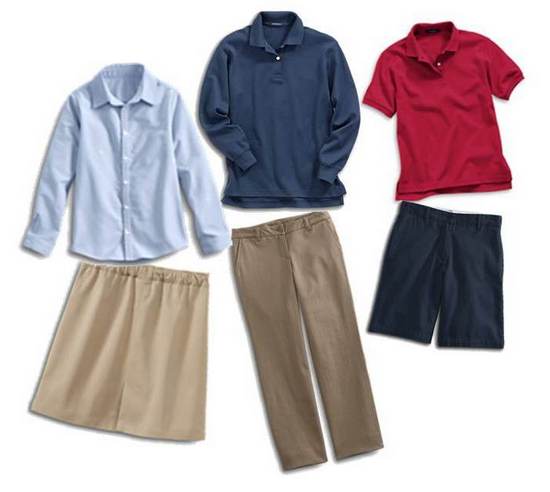
The new districtwide policy stated that the basic uniform for girls would be a long-or short-sleeved navy blue or white collared blouse or polo shirt with a dark blue, black, or khaki (tan) skirt, walking shorts, slacks, skort, or jumper made of denim, corduroy, or twill fabric. The basic uniform for boys would be a long-or short-sleeved navy blue or white collared shirt, such as a polo or oxford dress shirt, and a dark blue, black, or khaki (tan) pair of long pants or walking shorts made of denim, corduroy, or twill fabric. In addition, the new uniform code allowed the principal of each elementary or middle school to designate an official school T-shirt, one additional school color that could be worn on the top, and a school plaid that could be worn on the bottom.


Exemptions to the new uniform policy were allowed for the uniforms of national youth organizations, such as Boy Scouts and Girl Scouts, for students who were new to the school district (they had thirty days to buy their uniforms), and for students who objected to the uniform code on the basis of the sincerely held religious beliefs of their families. The dress code banned all emblems, words, phrases, or insignia--except buttons, armbands, or other symbols that students wore to exercise the right of free speech guaranteed by the United States Constitution.


Questions:


* Why do you suppose the district wanted all students to wear these clothes colors and styles?


* Does your school have a dress code? If so, do you like it, and, if not, how would you feel if you were dressed in this school uniform?


* Do you think it is a good idea to allow different schools to have their own color, plaid, and official T-shirt?


The Lawsuit


A class action lawsuit, filed by an attorney for more than five hundred families, alleged that the new uniform code placed the school in a position of authority and control over students' dress that is more properly exercised by parents and their children; caused school personnel to take actions that prohibited students from wearing clothing that contains political, religious, educational, commercial, and other forms of free speech; deflected the schools' attention from their primary educational purpose and mission; prevented students from choosing clothing that expressed their individuality, identity, gender, and ethnic and religious heritage; caused parents extra clothing expense because uniforms had to be purchased in addition to other regular clothes; was enforced differently from school to school; and created psychological stress, health, and safety concerns. The lawsuit asked that the school board overturn its new uniform policy and revert to its prior dress code, which did not limit students' and families' selections of styles, colors, or materials.


Questions:


* Who should have authority over what children wear to school--parents, children, or the school system?


* Why might it be difficult to enforce even a simple uniform code?


* In what ways are your clothes an expression of your gender, identity, and individuality?


The Incidents


The passage of the school district's new uniform code caused many problems once school started. In fact, more than one thousand "loaner outfits" had to be distributed on the first day of school. Here are a few examples of what happened.


* A vice principal at Westview Middle School suspected a girl was wearing Spandex (one of the forbidden fabrics). To verify this suspicion, the vice principal opened the girl's pants in order to view the tag. The result was that the girl was sent to In School Suspension (ISS) for having pants with a 4 percent Spandex content.


Questions:


* Do you feel that the vice principal's actions were justified and proper? Explain.


* Should any quantity of Spandex content be tolerated?


* A parent said that her second grade boy followed the roles at Auburn Elementary School by wearing navy blue pants. But he got in trouble when he wore a pair that was a little faded.


Questions:


* Should faded clothing be tolerated? Is navy blue still navy blue even when it is badly faded?


* A parent sent one of his children to school in a white polo-style shirt on which an American flag image and the text "God, please bless America one more time" had been printed. The child was made to change into a loaner shirt so that he could remain in class. (The loaner shirt had a large L on it that stands for "loaner" and thus identifies the child as a uniform code violator.)


Questions:


* Should patriotic slogans and emblems be allowed?


* Should "loaner" clothing be clearly marked?


* Many parents chose to send their children to school in uniforms, but with a small sticker or button of protest. Messages ranged from "Uniforms stink!" to "It's not what you wear, it's what you do" A large number of parents reported that their children were forced to remove the stickers or buttons under threat of severe discipline.


Questions:


* Why should or shouldn't there be limitations on students' rights to protest school policies? Who should decide these limits?


HANDOUT 2


ISSUE A DO SCHOOL UNIFORMS VIOLATE CONSTITUTIONAL RIGHTS?


Most Americans agree that freedom of speech gives people the right to express themselves in ways other than speech. This includes the right to write what you believe and to wear what you want. But should these rights be given to school children? And should these rights include the right for school students to wear anything?


These beliefs are built on the First Amendment to the U.S. Constitution, which states


   Congress shall make no law respecting an establishment of religion, or                                                                 
prohibiting the free exercise thereof; or abridging the freedom of speech,
or of the press; or the right of the people peaceably to assemble, and to
petition the government for a redress of grievances.
  The fights identified in the First Amendment were extended and strengthened by the passage of the Fourteenth Amendment, which seeks to guarantee that all citizens of the United States are treated equally under the law.  
   No state shall make or enforce any law which shall abridge the privileges                                                              
or immunities of citizens of the United States; nor shall any state deprive
any person of life, liberty, or property, without due process of law; nor
deny to any person within its jurisdiction the equal protection of the
laws.
  People who do not agree with school uniforms argue that uniforms violate the Fourteenth Amendment in several ways. Here are some examples of their complaints. * School uniforms do not allow students to wear clothing that reflects their religious or cultural beliefs.


* School uniforms do not allow special considerations for children with physical disabilities.


* School uniforms forcelarge-sized children to wear clothes that are unflattering, difficult to obtain, and harmful to their selfesteem.


* School uniforms cost additional money. Therefore, the policy discriminates against low-income children by increasing the cost of their "free" (tax-supported) public school education.


* Some children from low-income families are loaned uniforms. This clothing is often of poor quality, however, and sometimes is clearly identifiable (e.g., by a large letter L). Wearing this clothing is humiliating and embarrassing to children. Also, as the school does not always wash this clothing, it presents a health risk.


* Students removed from class for not complying with school uniform regulations are denied access to free public education.


Decisions Made by U.S. Courts


Over the years, judges in American courts have heard hundreds of cases concerning student dress. Many of the court rulings have sent mixed messages. Here is a summary of a few cases.


* In 1969, the Supreme Court recognized, in Tinker v. Des Moines Independent School District, that students do not lose their constitutional rights of citizenship when they enter through the schoolhouse door. The Court ruled that students should not have been suspended from school for wearing black armbands to protest the Vietnam War.


* In 1978, in Ferra v. Hendry County School Board, the court ruled that school boards have the right to prohibit a student from growing a mustache. The judge argued, "Ordinary matters such as these must be left in the hands of the officials who have been duly charged with the operation of our schools"


* In 1986, the Supreme Court, in Bethel School District No. 403 v. Fraser, ruled that students did not have the right to wear clothing that was lewd, vulgar, offensive, and against the values of civilized society.


Discuss and Decide


* What do you think about each case? How much authority do you think schools should have over how a person dresses or looks in school?


* Why do you think judges have differed so much in their decisions?


* How do you think the court will decide the Florida case?


Constitutional Considerations


School administrators and legal authorities say that schools have to maintain the balance between, on the one hand, giving students their First and Fourteenth Amendment rights, and, on the other hand, making sure that students come to school in a manner that does not prevent others from learning. Many people, therefore, suggest that student dress should be restricted if


* It is unhealthy or unsafe.


* It is offensive.


* It is gang related.


* It disrupts student learning.


The difficulty with each restriction is how to decide whether something is offensive, for example:


Consider the following situations. What would you decide if you were the school principal, and what is the basis for your decision?


* A middle school student wears a T-shirt with a slogan saying, "TEACHERS ARE STUPID."


* A teacher complains to you that a boy's really long hair stops him from working properly.


* Several students choose to wear trench coats similar to those worn by students who killed others at Columbine High School in Colorado in 1999.


* Cheerleaders at a middle school decide to wear their uniforms to class all day for each game day.


* A middle school student wears the same clothes to school for two weeks.


* A group of middle school students wears sunglasses in school.


Many people who use the First and Fourteenth Amendments to argue against school uniforms claim that all children are not treated equally under the strict uniform policies. How might a school uniform policy be written to give children from the following categories equal status?


* Children from low-income families


* Children with disabilities or other special physical characteristics


* Children from different cultural and religious backgrounds


HANDOUT 3


ISSUE B: WHO SHOULD DECIDE SCHOOL UNIFORM POLICIES?


Read these differing opinions about school uniforms.


Should the President Decide?


President Clinton, February 1996:


Quality education is critical to America's future and the future of our children and families. We cannot educate our children, however, in schools where weapons, gang violence, and drugs threaten their safety. We must do everything possible to ensure that schools provide a safe and secure environment where the values of discipline, hard work and study, responsibility, and respect can thrive and be passed on to our children....


Many school districts have made school uniforms an important part of an overall program to improve school safety and discipline. Too often, we learn that students resort to violence and theft simply to obtain designer clothes or fancy sneakers. Too often, we learn that clothing items worn at school, bearing special colors or insignias, are used to identify gang membership or instill fear among students and teachers alike.


If student uniforms can help deter school violence, promote discipline, and foster a better learning environment, then we should offer our strong support to the schools and parents that try them.


Should State Governors Decide? Governor William F. Weld (R-Mass.), February 1997:


School uniform is an idea whose time has come.... Little things can add up to a lot. Uniforms may seem like a little thing, but I think they're relevant to self-esteem, possibly even to confidence.


Should Members of Local School Boards Decide?


David Dubicheck, a Polk County school board member, May 2000:


Uniforms are a sensible idea and an effective way to help all children learn in an environment that is safe from gang violence, sets high standards of behavior, and ensures a calm classroom atmosphere. I believe all school districts should adopt uniform policies.


Should Parents Decide?


Maria Ponderosa, a Polk County parent, February 2000:


Uniforms restrict children's freedom to wear what they want. In schools where uniforms are mandated, teachers and administrators are turned into fashion police and not educators. No one should tell parents what their children should wear to school.


Arturo davis, a Polk County parent, June 2000:


Uniforms are a good way of making sure that all children are seen and treated equally. Also, kids don't go to school worried about what to wear, whether or not their clothes are cool, or perhaps even whether they are going to be attacked for wearing expensive clothes. Instead, all they have to concentrate on is doing well in class. That should be the main focus of any school.


Should Students Decide?


Latisha Watson, Pinehurst Middle School student, May 2000:


I hate wearing my school uniform. The colors are awful and the style is geeky. Every day I can't wait to get home from school and tear it off. Why can't I wear clothes that I like?


Andrew Jacobsen, Pinehurst Middle School student, May 2000:


Uniforms are great. You never have to think about what to wear to school. You just throw on your school uniform and off you go. Also, I know some friends who were beaten up by other kids for wearing gang colors--even though they had no idea they were doing it! I know that school uniforms make life easier and safer for students.


Discuss and Decide


Take each of the five categories separately. What arguments can be made for or against claims that each of the following should have a say in what students wear to school: (1) the U.S. President, (2) state governors, (3) local school board members, (4) parents, and/or (5) students?


HANDOUT 4


ISSUE C. ARE SCHOOL UNIFORMS EFFECTIVE?


Yes: Uniforms Do Improve Students' Behavior


On July 5, 1994, school uniforms became mandatory in all seventy Long Beach Unified School District elementary and middle schools. In spring 1995, this California school district began a study on the impact of school uniforms. Here is a summary of what the study concluded after comparing the 1993-94 school year with the 1994-95 school year.


* Elementary school suspensions declined by 28 percent (from 3,183 to 2,278).


* Middle school suspensions declined by 36 percent (from 2,813 to 1,814).


* Assault and battery decreased by 34 percent (from 319 to 212).


* Assault with a deadly weapon decreased by 50 percent (from 6 to 3).


* Fighting decreased by 51 percent (from 1,135 to 554).


* Robbery decreased by 65 percent (from 29 to 10).


* Possession of chemical substances decreased by 52 percent (from 165 to 78).


* Vandalism decreased by 18 percent (from 1,409 to 1355).


* One hundred percent of administrators, 86 percent of counselors, and 66 percent of teachers said that classrooms had less disruption.


* Eighty-four percent of counselors thought that students were more cooperative.


* Fifty-seven percent of teachers thought that student behavior had improved.


* Sixty-seven percent of parents believed that uniforms had improved the school environment.


* Eighty-two percent of parents believed that uniforms helped to remind students that they were going to school to learn.


Many educators and school officials believe that school uniforms are one way of preventing violence in schools. A 1990 report by Newsweek * illustrated the gravity of the problem. It pointed out that young people were fighting and even killing each other over clothes in poor areas of many American cities, such as New York, Detroit, Newark, Chicago, and Los Angeles. Among the cases cited were:


* In Detroit the previous year, an eighteen-year-old was shot and killed for his parka and for Nike sneakers worth $70.


* In Newark, police reported sixty-four armed robberies in a period of four months in which the attackers wanted leather or athletic jackets.


* In a six month period, four Chicago youths were killed for warm-up jackets valued between $90 and $200.


The report continued:


   Dressing for success has never been so risky. The combination of  
crack-quickened tempers, availability of guns, and the flashy clothes of
the drug culture have taken fashion awareness to a wicked level. Often, the
violence is triggered by gang symbols and colors. A brand of sneakers,
British Knights, has been adopted by Los Angeles's Crips gang, archrivals
of the Bloods. Crips like the shoes because the initials "B.K. can also
stand for "Blood Killers." In L.A. last year, a little gift unwittingly
wore a red sweater, apparently unaware it was also the color favored by the
Bloods. Someone, presumably a member of a rival gang, hit her on the head
with a rock.
  In response, a number of schools instituted dress codes. For example, * Crenshaw High School in Los Angeles banned symbols of gang allegiance, such as bandannas and dangling earrings worn by males.


* The Detroit Board of Education ordered Detroit schools to establish mandatory dress codes.


* At a school in Brooklyn, the principal banned excessive jewelry and shearling coats to prevent assaults on students who wore them.


* Nina Darton, "Bloodshed Over Clothes: Street Crimes of Fashion," Newsweek (March 5, 1990): 58.


No: Uniforms Do Not Improve Students' Behavior Some studies have shown that uniforms may have no direct impact on student behavior.


* Two professors from the University of Notre Dame questioned the Long Beach study. They claimed that other changes in Long Beach might have led to improvements in school behavior. In particular, they suggested that a $1 million grant to improve teaching methods in these schools might better explain students' improved behavior. The Notre Dame study concluded, "Our findings indicate that student uniforms have no direct effect on behavioral problems"


* Many students surveyed in Long Beach appeared to have a different impression of uniforms than their parents or teachers. The study noted,


   students responding to the survey did not perceive uniforms as positively                                                              
as adults did. The majority of middle-school children indicated uniforms
did not reduce fights (80.9%), did not help them fit in at school (76.4%),
and did not make them feel a part of the school (68.7%). In addition, 71.2
percent of the middle school students reported they did not feel safer
going to and from school. Elementary school students similarly reported
that uniforms did not make students fight less (77%), but that they did
make them feel part of the school (61%).
  * A 1998 Miami-Dade County, Florida, study also reported that mandatory uniforms might not have had a big impact on school children in their district. In middle schools, for example, where uniforms were mandatory, fights nearly doubled from 186 in 1996-97 to 284 in 1997-98.Discuss and Decide


Why do you think research on the effectiveness of school uniform produces such mixed results?


* Some people suggest that school uniforms may not fully explain why behavior in the Long Beach School District improved. What other factors might explain improved changes in student behavior?


* Some parents and teachers in Long Beach thought that school uniforms were very effective. But children were not so sure. why do you think their opinions differed so much?


HANDOUT 5


FOR MORE INFORMATION


WEBSITES


The Polk County School Uniform Website www.gate.net/~rwms/Uniform.html


Teachers may want to begin with this site. It looks directly at the issues in Polk County, Florida. The Polk County Uniform Policy page was created by parents who do not want mandatory uniforms in local schools. The site has links that include information on


* The original law suit


* The position of the American Civil Liberties Union (ACLU)


* A report by Gary Klahr on the constitutional legality of uniform policies


* The actual uniform policy enforced by the school district


* Newspaper articles that have reported on events in Polk County


* A report on research studies investigating the effectiveness of school uniforms (see "The Raging Debate" link on the home page)


The Education Commission of the States www.ecs.org/ecsmain.asp?page=/html/issues.asp?am=1


The Education Commission of the States (ECS Online) is a government-sponsored website that provides a wealth of information on educational issues. Click on the tab for Education Issues and then select Uniforms/Dress Codes to enter the area where the ECS has organized much of the debate on these topics. Teachers can also gain access to additional information on this site by typing in "school uniforms" in the search box. This will lead to dozens of links that offer information on school uniform policy.


The U.S. Department of Education www.ed.gov


This is a massive site administered by the federal government. Click the search tab, enter "school uniforms," and see several other links, including President Clinton's support for school uniforms. Be sure to look at the "Manual on School Uniforms" and "Student Dress Policies" in the ERIC Digest.


The American Civil Liberties Union www.aclu.org


The ACLU is an organization committed to preserving individual rights. The organization is not in favor of school uniforms and therefore offers a large collection of news releases and summaries of court cases that oppose school uniforms. To gain access to these resources, click the search box at the bottom of the main page and enter "school uniforms."


ARTICLES


Hundreds of articles have been written about school uniforms and school dress codes. Here are six selections taken from educational journals or magazines.


* Caruso, Peter. "Individuality vs. Conformity: The Issue behind School Uniforms" NASSP Bulletin 80, no. 581 (September 1996): 83-88.


This article in the Bulletin of the National Association of Secondary School Principals offers a good and brief overview of the arguments for and against uniforms.


* Cohn, Carla A. "Mandatory School Uniforms" The School Administrator (February 1996): 22-25.


The superintendent of Long Beach School District, California, explains the reasons for the alleged success of its uniform policy.


* Lane, Kenneth E., et al. "You Aren't What You Wear." The American School Board Journal 181, no. 3 (March 1994): 64-65.


This is a brief but useful guide to writing a uniform or dress code policy that will not violate students' constitutional rights. This piece may help formulate the final assignment.


* McCarthy, Martha M. "Can Educators Regulate Student Appearance in Public Schools?" Educational Horizons (Fall 1996): 11-14.


A brief look at some of the legal issues related to student appearance and dress in schools.


* Paliokas, Kathleen L., et al. "Trying Uniforms on for Size" The American School Board Journal 181, no. 5 (May 1996): 32-35.


This article examines the claims of effectiveness of school uniform policies and how legal uniforms are. It includes a good list of options that school boards have when designing codes. Excellent for the final written report.


* Stanley, M. Sue. "School Uniforms and Safety" Education and Urban Society 28, no. 4 (August 1996): 424435.


This detailed article examines the apparent success of the school uniform policy in Long Beach, California. The article investigates whether school uniforms are effective, and provides a good list of references at the end.


Notes


(1.) Donald Schneider, Susan A. Adler, R. Beery, Gloria Ladson-Billings, William R. Fernskes, H. Michael Hartoonian, Mary A. McFarland, Gerald Marker, Marjorie A. Montgomery, Pat Nickell, and Corrinne Tevis, Expectations of Excellence: Curriculum Standards for Social Studies (Washington, D.C.: National Council for the Social Studies, 1994).


(2.) L.H. Anderman and C. Midgley, Motivation and Middle School Students, ERIC Digest ED421281 (Champaign, Ill.: ERIC Clearing-house on Elementary and Early Childhood Education, 1998); and Robert G. Brown, "Middle School Social Studies and the Cognitive Revolution," Clearing House 72 (July-August 1999): 327-331.


(3.) H.E. Taylor and S. Larson, "Social and Emotional Learning in Middle School," Clearing House 72, (1999): 331-337; and Margaret J. Finders, "Raging Hormones: Stories of Adolescence and Implications for Teacher Preparation," Journal of Adolescent and Adult Literacy 42 (December 1998-January 1999): 252-264.


(4.) A more complete version of this and nine other NCSS themed case studies, titled Real-World Investigations for Middle and High School Social Studies, is forthcoming from Merrill Prentice Hall in 2003. This work was funded in part by a Contextual Teaching and Learning grant from the U.S. Department of Education.


John D. Hoge is Associate Professor of Social Education at the University of Georgia, Athens. Stuart J. Foster is Senior Associate of the Institute of Education, University of London, England. Pat Nickell is a social studies consultant in Venice, Florida. Sherry L. Field is an associate professor of social studies education at the University of Texas-Austin.
 
< Prev   Next >

Service features

24/7 customer support

Written from scratch papers only

Any citation style

Fully referenced

Never resold papers

275 words per page Courier New font